
MALDIVES
The Maldives, Reimagined
Where Quiet Luxury Meets the Edge of the World
MALDIVES
The Maldives, Reimagined
Where Quiet Luxury Meets the Edge of the World
There is a particular kind of silence in the Maldives — not the absence of sound, but the presence of nothing else. No traffic pressing against the day. No horizon interrupted by anything but water finding the sky. In this Maldives travel guide, we journey beyond the familiar postcard to discover an archipelago shaped by living reefs, quiet islands and the rhythm of the ocean.
For years, the Maldives has been defined by a single beautiful image: an overwater villa suspended above a turquoise lagoon, a glass floor and champagne at sunset. Yet beyond that familiar picture lies a more compelling story — twenty-six natural atolls, remote island communities and extraordinary encounters with manta rays, whale sharks and coral worlds alive beneath the surface.
For FemmVoyage, this is where the real journey begins. Not with luxury placed above nature, but with thoughtful island stays shaped by it. Places where conservation gives beauty a deeper meaning, where stillness feels like a privilege and where two generations can experience the same ocean through different eyes. Atoll by atoll, reef by reef — with the ocean always remaining the main character.
Not simply as honeymoon escapes.
Not only as dream beaches.
But as living islands where nature, hospitality and long-term protection meet.
Beyond the postcard lies a different Maldives — one shaped by living reefs, extraordinary wildlife and the quiet luxury of allowing the ocean to lead.
BEYOND THE POSTCARD
Maldives Travel Guide: Twenty-Six Atolls and a Different Story on Each One
The average visitor sees perhaps three or four of the Maldives’ twenty-six natural atolls, and for many, that is enough. The resort island becomes the destination, while the archipelago beyond it remains part of the view.
But each atoll carries its own temperament.
Fly north into Baa Atoll and the water turns the colour of pale jade before you even land, the plane’s shadow chasing itself across sandbanks that may disappear again with the evening tide. Travel farther south into Laamu and the reefs feel wilder, shaped more visibly by channels and currents — the Maldives as it might have appeared before anyone thought to photograph it.
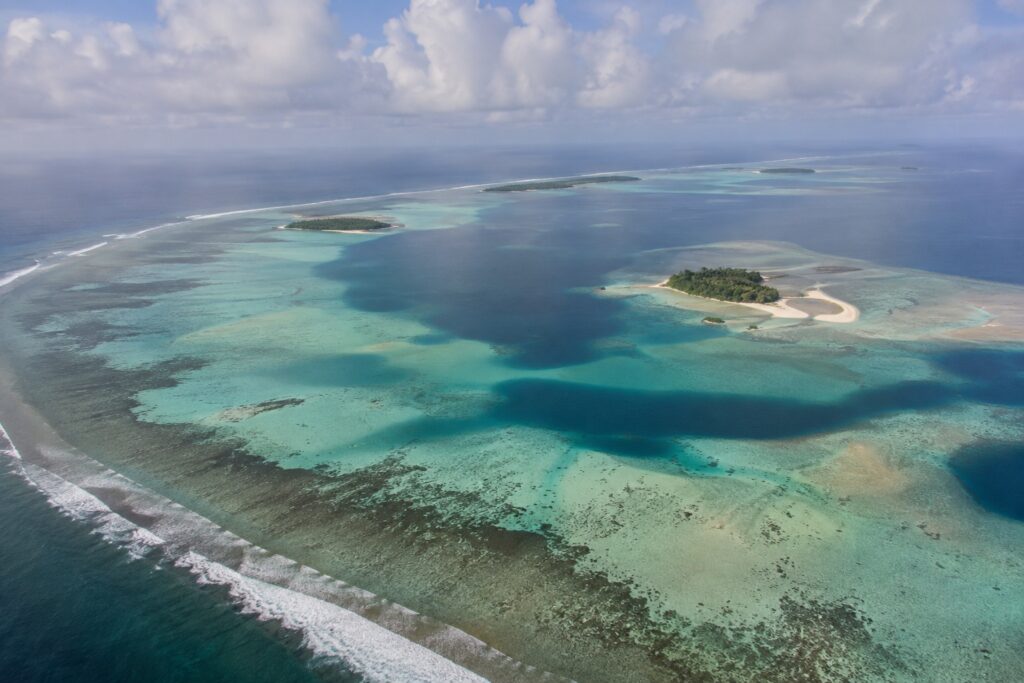
Choosing an atoll, not merely a resort, is the first mark of a traveller who has done the reading rather than only the scrolling.
Baa Atoll, recognised as a UNESCO Biosphere Reserve, offers Hanifaru Bay: an extraordinarily small stretch of water known for hosting some of the world’s largest manta ray gatherings. During the southwest monsoon, plankton carried by tides and currents can draw reef mantas into the bay in remarkable numbers.
These encounters remain entirely dependent on wildlife, tides and ocean conditions. Nothing can be guaranteed — and that uncertainty is part of what keeps the experience wild.
Elsewhere, South Ari Atoll is known for year-round possibilities of encountering whale sharks, while Raa and Noonu offer quieter island settings and some of the Maldives’ most interesting conservation-led resorts. Laamu feels more remote and elemental; Addu introduces a different southern landscape shaped by reefs, local communities, mangroves and wetland ecosystems.
The resort determines where you stay.
The atoll determines the world that surrounds you.
QUIET LUXURY
A Villa Is Not the Point. The Water Around It Is.
What makes the Maldives structurally unlike almost anywhere else is its scale relative to privacy. A resort often occupies an entire island, sometimes barely a few hundred metres across, which means arrival becomes its own kind of decompression.
There is no town beyond the property line. No road continuing into the distance. No other guests beyond those sharing your particular stretch of island and reef.
The finest Maldives overwater villas have understood this and stopped competing only on square metres. Instead, they offer a private ladder descending into the lagoon, the sound of the tide moving beneath the floor after dark and a house reef close enough to explore before breakfast.
Yet the villa itself is not the experience.
It is simply where you sleep between the experiences the water is offering.
Conservation
The Reef Became the Guest Programme, Not the Brochure Line
The most meaningful shift in the Maldives over the past decade has little to do with design. It is the quiet arrival of resident marine biologists, coral propagation laboratories and reef-restoration programmes that invite guests to participate with their hands in the water, rather than simply read about conservation on a card left beside the bed.
Across Baa, Raa and Noonu Atolls, several forward-thinking resorts now maintain coral nurseries where damaged fragments are carefully attached to underwater frames and monitored as they begin to grow.
A guest may help plant a coral frame during the first afternoon of a stay and, returning years later, discover that it has become part of a living reef. What begins as a single experience can grow into a lasting relationship with one particular corner of the ocean.
This is where luxury in the Maldives finds a deeper meaning.
Not in placing comfort above nature, but in allowing exceptional hospitality to support the ecosystems that make these islands possible. Conservation is no longer simply a line in the brochure. At the most thoughtful resorts, it has become part of the journey itself.
The most meaningful shift in the Maldives over the past decade has little to do with design. It is the quiet arrival of resident marine biologists, coral propagation laboratories and reef-restoration programmes that invite guests to participate with their hands in the water, rather than simply read about conservation on a card left beside the bed.
Across Baa, Raa and Noonu Atolls, several forward-thinking resorts now maintain coral nurseries where damaged fragments are carefully attached to underwater frames and monitored as they begin to grow.
A guest may help plant a coral frame during the first afternoon of a stay and, returning years later, discover that it has become part of a living reef. What begins as a single experience can grow into a lasting relationship with one particular corner of the ocean.
This is where luxury in the Maldives finds a deeper meaning.
Not in placing comfort above nature, but in allowing exceptional hospitality to support the ecosystems that make these islands possible. Conservation is no longer simply a line in the brochure. At the most thoughtful resorts, it has become part of the journey itself.
Island rhythms
How a Day Here Is Meant to Be Read
Morning belongs to the reef, before the light becomes too bright and while the lagoon is still as smooth as glass. It may begin with a quiet swim along the house reef or a dawn cruise past dolphins that seem entirely unbothered by the boat moving beside them.
By midday, the pace slows even further. An overwater spa treatment follows the rhythm of the tide, lunch stretches without a schedule and doing nothing at all begins to feel like an experience in itself.
Late afternoon brings its own small ritual: travelling by traditional dhoni towards a private sandbank, uninhabited and surrounded by open water. A table may be prepared for two on a stretch of sand that will disappear beneath the next high tide.
Evening arrives softly. Dinner is served beside the reef by candlelight, while the absence of light pollution allows the night sky to become part of the experience. At some of the Maldives’ most thoughtful resorts, a resident astronomer guides guests through constellations that are often invisible from home.
None of this needs to be crowded into a strict itinerary.
The best Maldivian island stays are designed so that doing very little feels, correctly, like the entire reason for coming.
In the Maldives, the tide keeps time so you do not have to.
The Season Most Maldives Travel Guides Get Wrong
Conventional wisdom sends travellers to the Maldives between December and April, in search of calm seas, clear skies and the near-perfect visibility associated with the dry season.
The conditions can be extraordinary. Yet they tell only one side of the seasonal story.
From May through November, the so-called green season brings a quieter and often more compelling rhythm. There may be tropical showers and greater movement in the ocean, but there are also fewer travellers, softer resort rates and landscapes refreshed by the rain.
More importantly, seasonal currents carry plankton into parts of the archipelago, attracting manta rays and whale sharks to feed. In places such as Hanifaru Bay in Baa Atoll, this can create some of the Maldives’ most remarkable marine encounters.
For travellers choosing their journey around the living reef rather than perfect weather alone, the green season is not necessarily a compromise.
It may be the more thoughtful and better-informed time to visit.
The best time to visit depends on what you hope the ocean will reveal.
Choosing Your Maldives Atoll
Choosing the right Maldives atoll shapes far more than the journey to your resort. It determines the surrounding marine life, the character of the reef, the sense of remoteness and even the rhythm of your stay.
Beyond the postcard lies a different Maldives — one shaped by living reefs, extraordinary wildlife and the quiet luxury of allowing the ocean to lead.
Island stays
Three distinctive islands. Three different ways to experience the Maldives.
The journey begins with a place. The story begins with what it changes in you.
In-depth journeys to the world’s most inspiring places — where luxury, nature and storytelling meet.
Thoughtful inspiration, new guides and seasonal ideas delivered to your inbox